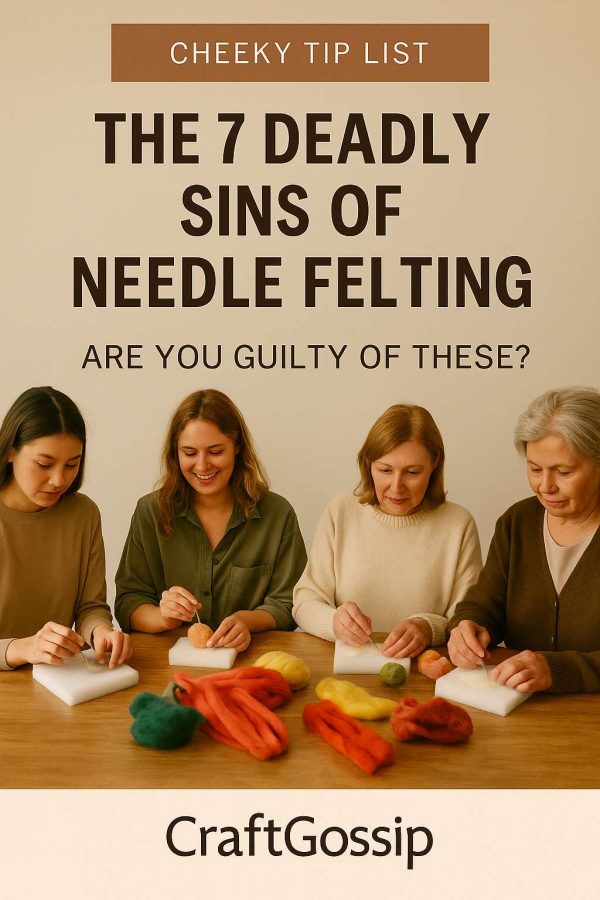
We’ve all been there — sitting at the felting mat, stabbing away with excitement, only to end up with a lumpy blob instead of a cute bunny. Or worse, breaking yet another needle (and muttering words not fit for polite crafting circles).
Needle felting can be equal parts therapy and chaos — but most of the “fails” come down to a few classic beginner mistakes. The good news? They’re all fixable.
So, grab your favorite felting needle (and maybe a cup of tea), because we’re diving into the 7 Deadly Sins of Needle Felting — and how to redeem yourself before your next project.
1. The Sin of the Wrong Needle
You know the one — the “all needles are the same” myth.
Using the wrong gauge or shape can completely ruin your project. A coarse needle (like a 36) will felt faster but can leave holes or destroy delicate areas. A fine 40 is perfect for details, but use it too early and it’ll bend faster than you can say “ouch.”
Craft Confession: We’ve all tried to finish an entire project with one needle. Don’t.
The Fix:
Keep a small variety on hand:
- 36 gauge – base work and firming up big pieces.
- 38 gauge – general shaping.
- 40 gauge – fine detailing and surface work.
Treat them like brushes in painting — each has a purpose.
2. The Sin of Over-Stabbing
If your project looks more like a crime scene than a craft table… this one’s for you.
Needle felting is about patience and precision, not aggression. Over-stabbing compacts the wool too quickly, making it impossible to add or blend later. It can also cause the surface to look rough, uneven, or “pitted.”
The Fix:
Slow down and let the needle do the work. You’re guiding the fibers, not punishing them. Gentle, consistent pokes will build a smoother surface and save your wrists (and your sanity).
3. The Sin of Skipping Layers
Ah yes, the “giant ball of wool” approach — where you grab a massive handful, stab for an hour, and wonder why nothing’s firming up.
Needle felting works best in layers. Building shape gradually helps control density, prevents cracking, and makes adding details so much easier.
The Fix:
Start with a small core and wrap thin layers of wool around it as you go. Think onion, not potato.
4. The Sin of Ignoring Fiber Type
Not all wool is created equal. Trying to needle felt with slick Merino top is like trying to sculpt with silk — lovely, but not practical.
If you’re struggling to get your wool to felt, it’s probably because the fibers are too fine or treated for spinning, not stabbing.
The Fix:
Use coarser wools (like Corriedale, Romney, or Shetland) for structure and Merino for top layers or blending.
Bonus tip: Create a wool sampler! Once you’ve felted a few breeds, you’ll feel the difference immediately.
5. The Sin of Neglecting the Mat
That sad, flattened foam block you’ve been using since last winter? Yeah, it’s time.
Using a worn-out or wrong surface can break needles, warp shapes, and leave fibers embedded in the base. Your project deserves better.
The Fix:
Invest in a good felting mat — dense foam, wool pad, or brush-style. Replace it when it starts to compress or crumble.
Want a thrifty fix? Stack two old foam mats together or wrap one in felt to extend its life.
6. The Sin of Rushing the Finish
You’re almost done. It looks adorable. You just want to… stop.
But if your piece is still soft or fuzzy, that “almost” will come back to haunt you.
A half-felted project loses its shape easily, sheds fibers, and looks unfinished.
The Fix:
Keep stabbing until your piece feels firm and resilient — like a dense sponge. Use finer needles toward the end for a smooth surface.
Then, finish with a quick once-over using a fine needle at a shallow angle to neaten up flyaway fibers.
7. The Sin of Forgetting to Have Fun
The most dangerous sin of all — taking felting too seriously.
Every misshapen sheep or lumpy penguin is part of your creative evolution. The best felters didn’t start with perfect animals; they started with blobs that might have been animals if you squinted.
The Fix:
Laugh, experiment, and embrace imperfection. The charm of needle felting lies in its handmade character — no two creatures should ever look identical.
Needle Felting Redemption Checklist
Before your next project, ask yourself:
Am I using the right needle for the stage?
Am I building up in layers?
Is my surface clean and supportive?
Did I stop to feel the wool as I work?
Am I still having fun?
If you can answer “yes” to all five — you’re officially absolved.
Needle felting is equal parts craft, meditation, and a little chaos therapy. Once you let go of perfection and learn the quirks of the wool, it becomes a joyful, mindful process.
So go ahead — forgive your past felting sins, grab that needle, and start fresh. Every poke brings you one step closer to handmade magic.