There’s always that one question I get from new felters (and let’s be honest, from seasoned crafters who’ve accidentally bought the wrong roving online): “What’s the difference between Merino and Corriedale wool?”
If you’ve ever held both in your hands, you already know they feel completely different. Merino is soft as butter, glides through your fingers, and almost melts when you felt it. Corriedale, on the other hand, has a little spring — a bounce that makes it perfect for sculpting and structure.
But here’s the truth: both are fantastic fibers. You just need to know when to use each — and how to make them work for you, not against you.
Let’s break down how these two felting favourites compare in softness, structure, and felting performance, so you can confidently choose the right wool for your next project.
Meet the Fibers: Merino and Corriedale at a Glance
Merino Wool – The Silky Smooth Staple
Merino is the diva of the wool world — luxurious, elegant, and a little high-maintenance (but worth every minute). Originating from Merino sheep in Spain and now farmed widely in Australia and New Zealand, it’s famous for its incredibly fine fibers, usually between 18–22 microns.
What that means for us felters: Merino is super soft and felts beautifully smooth. The fibers have tiny, closely spaced scales that tangle delicately but evenly, producing a sleek surface ideal for wet felting and wearable art.
Best For:
- Wet felting scarves, wraps, and fabric
- Nuno felting on silk or gauze
- Delicate surface layers and fine color blending
- Projects where softness and drape matter
What You’ll Love:
- Felts into smooth, seamless fabric
- Wonderful for blending colors and gradients
- Luxurious to touch and wear
- Creates minimal fuzz or texture
What to Watch Out For:
- Felts slower than coarser fibers
- Can over-shrink or lose structure if overworked
- Not ideal for firm needle-felted sculptures
Corriedale Wool – The Reliable All-Rounder
If Merino is your silk dress, Corriedale is your favorite denim jacket — reliable, strong, and versatile. Bred from a cross between Merino and Lincoln sheep, Corriedale combines softness with durability. Its fibers are slightly thicker, around 25–30 microns, and have more defined crimp and elasticity.
In plain English: Corriedale grabs onto itself faster and felts quicker than Merino. It’s the go-to wool for felters who want control and speed without losing softness.
Best For:
- Needle felting animals and 3D shapes
- Wet felting bags, slippers, and structural pieces
- Beginners learning to felt (less fussy than Merino)
- Core wool for larger sculptural projects
What You’ll Love:
- Felts quickly and evenly
- Holds its shape beautifully
- Slightly springy feel for sculpting
- Naturally matte, giving a rustic handmade finish
What to Watch Out For:
- Not as silky or smooth as Merino
- Slightly coarser texture may show in delicate wearables
Side-by-Side Comparison
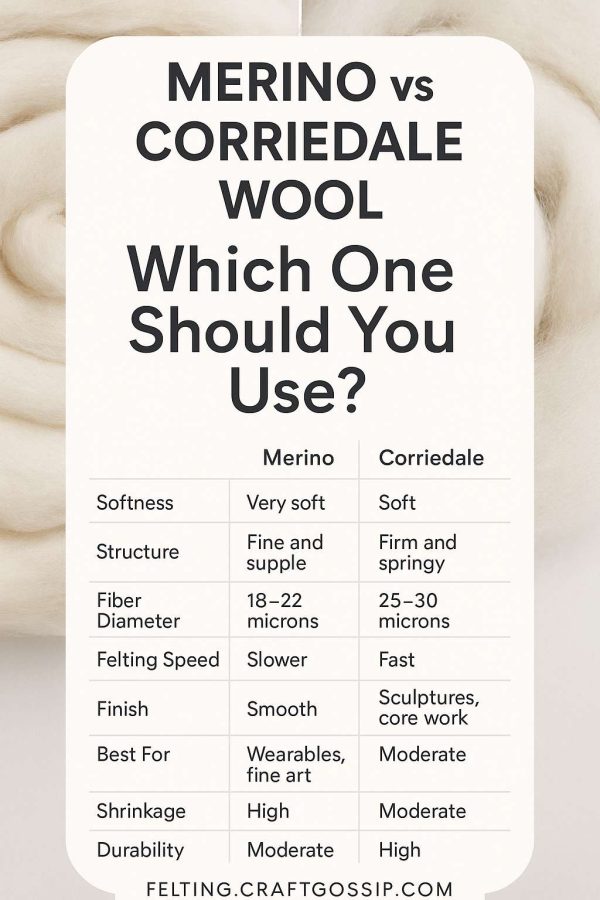
| Feature | Merino Wool | Corriedale Wool |
| Fiber Diameter | 18–22 microns (fine) | 25–30 microns (medium) |
| Texture | Silky, smooth | Bouncy, slightly coarse |
| Felting Speed | Slow | Fast |
| Finish | Polished and refined | Matte and textured |
| Best For | Nuno felting, wearables | Sculptures, core work, beginners |
| Shrinkage | High | Moderate |
| Durability | Delicate | Strong and stable |
| Ease of Use | Requires patience | Beginner-friendly |
Felting with Merino Wool
Felting with Merino is like painting with watercolor — it’s about flow, softness, and subtlety. When wet felting, its fine fibers create thin, elegant sheets that drape beautifully. It’s also ideal for layering colors — you can blend hues to create painterly effects, perfect for wall art or scarves.
Tips for Success:
- Work gently — over-agitating can cause uneven shrinkage.
- Use warm (not hot) water and soft rolling to maintain smoothness.
- Combine with silk for lightweight nuno felting.
- Be patient — fine fibers need more time to lock together.
Felting with Corriedale Wool
Corriedale behaves like it’s made for felting. The fibers tangle easily and hold firm, which means less frustration and faster progress. For needle felting, Corriedale is a dream — it sculpts easily without excessive fuzzing. For wet felting, it firms up quickly, forming thick, durable fabric that’s great for slippers, handbags, or felted bowls.
Tips for Success:
- Use Corriedale for core shapes — it saves time and wool.
- Combine with finer fibers for smoother finishes.
- Perfect for teaching beginners — it’s forgiving and consistent.
- Great for projects that need to keep their structure.
Texture and Appearance
Merino produces a sleek, silky finish — think “refined elegance.” It’s ideal for wearable pieces where the fiber will sit close to the skin.
Corriedale, in contrast, creates a rustic, natural surface that feels organic and slightly textured. It’s perfect for earthy, artistic projects or anything that benefits from a tactile feel.
Want the best of both worlds? Try layering Corriedale underneath and Merino on top. The Corriedale gives strength and form, while Merino delivers that ultra-smooth finish.
Which Felts Faster?
If speed matters (and sometimes it really does when you’re teaching workshops or batch-making gifts), Corriedale wins hands down.
Its coarser scales catch faster, meaning it felts quickly with both needle and wet methods.
Merino takes longer to lock, but rewards patience with a smooth, flawless result.
Cost Comparison
Corriedale is typically more affordable than Merino, which makes it ideal for beginners, workshops, and large-scale projects. Merino, being a luxury fiber, costs more but delivers unmatched softness and visual appeal — well worth the splurge for wearables or gifts.
Breeds and Sustainability
Both Merino and Corriedale sheep are raised around the world, primarily in New Zealand and Australia. Many small farms now offer ethically sourced, mulesing-free wool, so check your supplier’s details if sustainability matters to you. Supporting local or small-batch producers not only helps the environment but also gives you a better feel for fiber quality and processing.
Project Pairings
| Project Type | Recommended Wool | Why |
| Nuno Felt Scarf | Merino | Fine and soft, drapes beautifully |
| Needle Felt Animal | Corriedale | Firm, holds shape easily |
| Felted Bag or Slippers | Corriedale | Strong and durable |
| Wall Art or Painting with Wool | Merino | Smooth, blends colors well |
| Beginner Wet Felting | Corriedale | Quick and forgiving |
| Luxury Gift Item | Merino | Elegant and silky finish |
Blending Merino and Corriedale
Some of my favorite pieces use both fibers together. Try using Corriedale for structure and Merino for finish. For example, felt your slippers in Corriedale, then add a soft Merino layer for comfort and beauty.
The fibers complement each other beautifully — Merino adds drape, Corriedale adds stability.
If you’re felting for the first time, start with Corriedale. It’s easy to control, felts fast, and lets you understand the process without fighting your fiber.
If you’re experienced and chasing that smooth, buttery, high-end look, Merino is your soulmate. It takes more patience, but the results are worth it — silky, refined, and oh-so-soft.
And if you’re like me? You’ll keep both on your shelf and choose depending on your creative mood — some days you want rustic charm, others you crave elegance. That’s the joy of felting: the fiber truly shapes the art.